What Is an E-commerce Supply Chain?
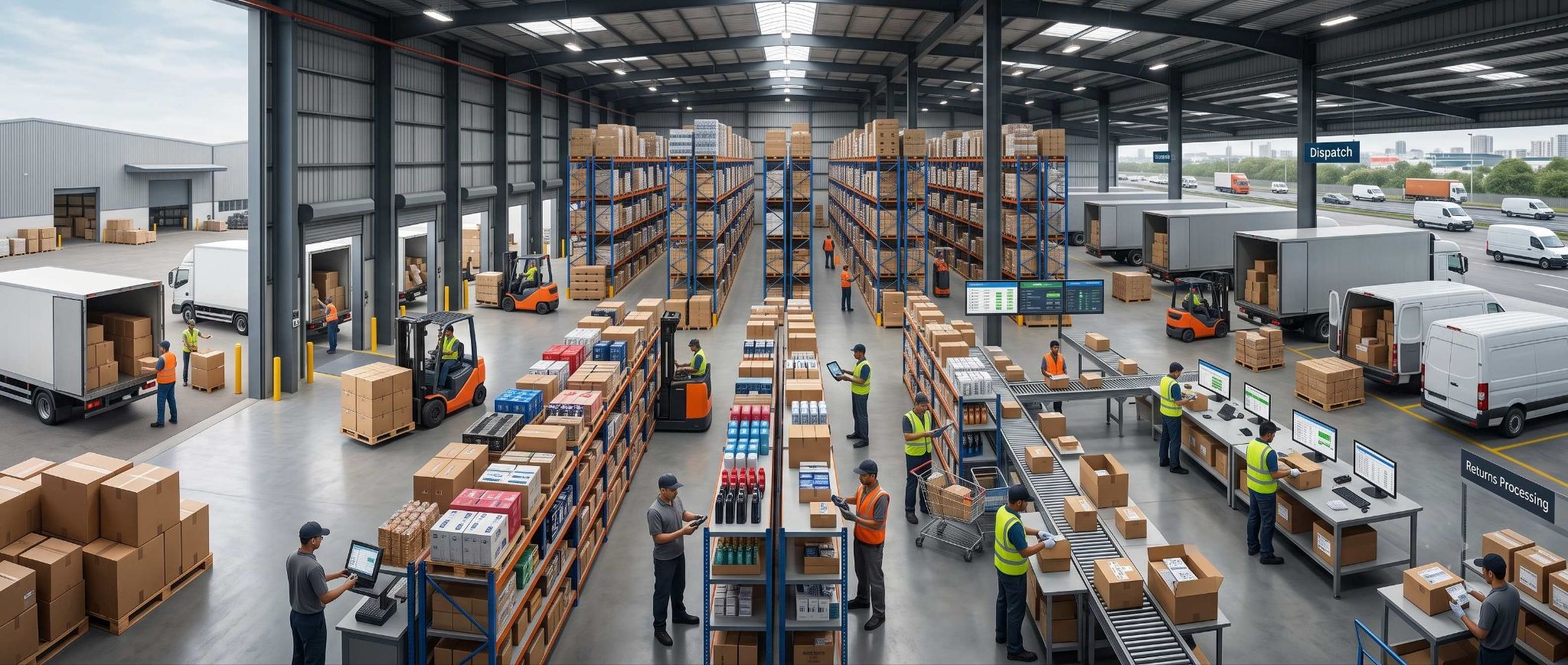
An ecommerce supply chain is the connected system of processes, people, technology, facilities, and logistics partners involved in moving products from suppliers to online customers.
It starts before a customer places an order.
A typical e-commerce supply chain can include:
Procurement → Inventory → Warehousing → Order Processing → Fulfillment → Shipping → Delivery → Returns
Each stage affects the next.
For example, inaccurate inventory data can cause a product to be shown as available when it is actually out of stock. That can lead to order cancellations or delays. Similarly, inefficient warehousing can slow down fulfillment, while poor delivery planning can affect the customer’s experience even when the order was processed correctly.
This is why e-commerce supply chain management is not simply about delivering products. It is about coordinating the entire flow of inventory and information so that the right products are available, processed, and delivered at the right time.
For growing brands, this becomes increasingly important as order volumes increase and businesses expand across D2C websites, marketplaces, Q-commerce, B2B, and other channels.
How Does an E-commerce Supply Chain Work?
The e-commerce supply chain can be understood as a sequence of connected activities.
1. Procurement and Sourcing
The process begins with sourcing products or raw materials from suppliers or manufacturers.
Businesses need to determine what products they require, how much inventory they need, and when additional inventory should arrive.
Good procurement planning helps reduce the risk of both stockouts and excessive inventory.
2. Inventory Management
Once products are procured, businesses need to track them throughout their supply chain.
Inventory management answers questions such as:
- How much stock is available?
- Where is the inventory located?
- Which products are selling fastest?
- Which SKUs are approaching low-stock levels?
- How much inventory is committed to existing orders?
- When should stock be replenished?
Technology such as inventory management software, barcodes, and other tracking systems can provide greater visibility into stock movement.
3. Warehousing
Inventory needs to be stored somewhere before it reaches the customer.
An e-commerce warehouse receives products, stores them, manages inventory, and prepares orders for fulfillment.
For growing brands, warehousing is not simply about having enough floor space. The location, layout, inventory systems, handling processes, and proximity to customers can all affect the efficiency of the supply chain.
4. Order Processing
When a customer places an order through an e-commerce website or marketplace, the order enters the fulfillment process.
Order processing can involve:
- Order validation
- Payment confirmation
- Inventory allocation
- Picking instructions
- Shipping selection
- Order status updates
Accurate order processing is important because errors at this stage can affect every subsequent step.
5. Fulfillment
Fulfillment involves turning an online order into a shipment.
The basic process includes:
Order Received → Pick → Pack → Label → Dispatch
The warehouse identifies the products, picks them from storage, packs them according to requirements, and prepares the shipment for transportation.
6. Transportation and Delivery
After fulfillment, the order moves through the logistics network toward the customer.
Transportation can involve multiple stages depending on the destination and delivery model.
The goal is to deliver the correct order within the expected timeframe while managing transportation costs effectively.
7. Returns and Reverse Logistics
The supply chain does not necessarily end when the product reaches the customer.
If the customer returns an order, the product moves backward through the supply chain.
This is known as reverse logistics.
Depending on the product and return condition, the returned item may be:
- Inspected
- Restocked
- Refurbished
- Repacked
- Returned to the supplier
- Disposed of according to applicable processes
Returns management is therefore an important component of e-commerce supply chain operations.
E-commerce Supply Chain: Key Components at a Glance
| Supply Chain Component | Primary Function |
| Procurement | Sources products or raw materials |
| Inventory Management | Tracks stock and inventory movement |
| Warehousing | Stores and manages products |
| Order Management | Captures and processes customer orders |
| Fulfillment | Picks, packs, and prepares orders |
| Transportation | Moves products between locations |
| Last-Mile Delivery | Delivers orders to customers |
| Returns Management | Handles returned products and reverse logistics |
| Technology | Connects data, orders, inventory, and operations |
These components are interconnected rather than operating independently.
How Inventory, Warehousing, Fulfillment and Delivery Work Together
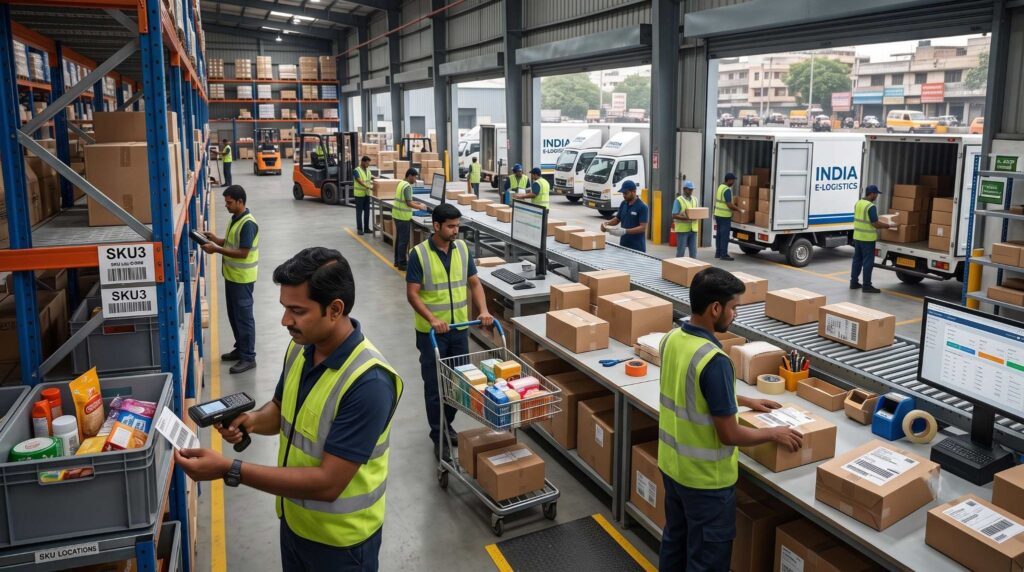
The biggest misconception about an e-commerce supply chain is that each function can be optimized separately.
In reality, they depend on one another.
Consider a customer ordering a product online.
Inventory
The system needs to know that the product is available.
Warehouse
The product needs to be physically available at the expected location.
Fulfillment
The warehouse team needs to pick and pack the correct product.
Transportation
A logistics partner needs to receive the shipment and move it toward the destination.
Delivery
The shipment needs to reach the customer within the expected timeframe.
If any one of these stages fails, the customer can experience a problem.
For example:
Incorrect inventory → order accepted → warehouse cannot find product → fulfillment delayed → shipment delayed → customer dissatisfaction
This is why supply chain management is fundamentally about coordination and visibility.
Why Is E-commerce Supply Chain Management Important?
An efficient supply chain can directly influence the economics and customer experience of an online business.
1. Better Inventory Availability
Effective planning and inventory control can help brands reduce unnecessary stockouts and overstocking.
2. Faster Order Processing
Connected systems and standardized warehouse processes can reduce delays between receiving an order and dispatching it.
3. Improved Customer Experience
Customers expect accurate orders, predictable delivery, and straightforward returns.
The supply chain is responsible for much of this experience behind the scenes.
4. Lower Operational Costs
Better demand planning, inventory control, warehouse utilization, and transportation management can help reduce unnecessary operating costs.
5. Easier Business Scaling
A scalable supply chain allows a brand to handle increasing order volumes and enter new markets without every operational function becoming a bottleneck.
6. Better Decision-Making
Supply chain data can provide insight into inventory levels, order volumes, delivery performance, and operational efficiency.
What Role Does Technology Play in an E-commerce Supply Chain?
Technology connects the different parts of the supply chain.
A growing e-commerce brand may use several systems.
Inventory Management System
Tracks inventory levels, stock movement, and availability.
Warehouse Management System
Helps manage warehouse activities such as receiving, storage, picking, packing, and inventory movement.
Order Management System
Centralizes orders from different sales channels and helps coordinate their fulfillment.
Enterprise Resource Planning
ERP systems can connect supply chain information with broader business functions such as procurement, finance, and operations.
Barcode and Scanning Systems
Barcodes can help identify products and track inventory through warehouse processes.
Analytics and Reporting
Supply chain data can help brands identify demand patterns, fulfillment delays, inventory issues, and delivery performance.
The objective is not to add technology simply for the sake of automation.
The objective is to create better visibility and coordination across the supply chain.
How Does an E-commerce Supply Chain Support Multiple Sales Channels?
Many brands no longer sell through just one channel.
A growing brand might simultaneously operate through:
- Its own D2C website
- Amazon
- Flipkart
- Myntra
- Meesho
- Q-commerce platforms
- B2B channels
- Modern trade
- Traditional distribution
Each additional channel can create new operational requirements.
For example, inventory allocated to a marketplace order should not accidentally be sold through another channel if the stock is unavailable.
This makes centralized inventory visibility and coordinated order management increasingly important.
An effective supply chain should therefore be designed around the overall business, rather than treating every sales channel as a completely separate operation.
What Are the Biggest E-commerce Supply Chain Challenges?
Inventory Inaccuracy
If the system does not accurately reflect physical stock, brands can experience overselling, stockouts, and delayed orders.
Overstocking
Holding too much inventory can tie up working capital and increase storage costs.
Stockouts
Insufficient inventory can result in lost sales and poor customer experiences.
Fragmented Systems
When different sales channels, warehouses, and logistics partners operate without sufficient integration, obtaining accurate information becomes difficult.
Delivery Delays
Transportation problems, warehouse delays, incorrect addresses, or poor coordination can affect delivery performance.
Returns
High return volumes can create additional transportation, inspection, inventory, and customer-service requirements.
Seasonal Demand
Festive periods, promotions, product launches, and other events can create sudden increases in order volume.
A scalable supply chain needs enough flexibility to respond without creating excessive permanent capacity.
How Can Brands Improve Their E-commerce Supply Chain?
Improving an e-commerce supply chain does not necessarily mean replacing every system.
Brands can start by identifying the biggest operational bottlenecks.
Step 1: Map the Current Supply Chain
Document how inventory moves from suppliers to warehouses and eventually to customers.
Step 2: Identify Bottlenecks
Look for delays or recurring problems in procurement, inventory, warehousing, fulfillment, transportation, or returns.
Step 3: Improve Inventory Visibility
Create a reliable view of inventory across warehouses and sales channels.
Step 4: Standardize Fulfillment
Define consistent processes for receiving, picking, packing, dispatch, and returns.
Step 5: Evaluate Warehouse Locations
As the customer base expands, assess whether inventory should be distributed across additional locations.
Step 6: Integrate Sales Channels
Where practical, connect websites and marketplaces with order and inventory systems.
Step 7: Track Key Metrics
Monitor metrics such as:
- Inventory accuracy
- Order fulfillment time
- Order accuracy
- Stockout rate
- Inventory turnover
- On-time delivery
- Return rate
- Cost per order
Step 8: Plan for Scale
The supply chain should be able to handle growth, seasonal peaks, and new sales channels without requiring a complete redesign every time the business expands.
Centralized vs. Distributed E-commerce Supply Chain
One important decision for growing brands is whether inventory should remain concentrated in one location or distributed across multiple locations.
| Model | Advantages | Potential Challenges |
| Centralized | Simpler inventory management, fewer facilities | Longer delivery distances to some markets |
| Distributed | Inventory closer to customers, potentially faster regional fulfillment | More complex inventory management |
| Hybrid | Balances central inventory with regional stock | Requires stronger planning and visibility |
There is no universal answer.
The right model depends on customer geography, product demand, delivery expectations, inventory value, warehouse costs, and sales-channel requirements.
E-commerce Supply Chain Metrics Brands Should Track
Measuring supply chain performance helps identify where operational improvements are needed.
| Metric | What It Measures |
| Inventory Accuracy | Difference between recorded and physical stock |
| Order Accuracy | Percentage of orders fulfilled correctly |
| Order Fulfillment Time | Time required to process an order |
| Stockout Rate | Frequency of products becoming unavailable |
| Inventory Turnover | How efficiently inventory is being sold |
| On-Time Delivery | Orders delivered within the expected timeframe |
| Return Rate | Percentage of orders returned |
| Cost per Order | Operational cost associated with fulfillment |
| Order Cycle Time | Time from order placement to delivery |
Tracking these metrics together provides a more complete picture than looking at delivery speed alone.
E-commerce Supply Chain vs. E-commerce Fulfillment
The two terms are related but not identical.
E-commerce fulfillment primarily concerns what happens after an order is received—such as picking, packing, dispatch, and delivery coordination.
E-commerce supply chain management covers a much broader system, including procurement, inventory planning, warehousing, fulfillment, transportation, delivery, and returns.
In simple terms:
Fulfillment is one part of the e-commerce supply chain.
This distinction matters because improving fulfillment alone cannot solve problems caused by poor procurement, inaccurate inventory, inadequate warehouse capacity, or inefficient distribution.
How Goldfishh EMBRACE Supports E-commerce Supply Chain Growth
For growing brands, supply chain requirements often become more complicated as they expand across marketplaces, Q-commerce, D2C websites, and B2B channels.
This is where Goldfishh EMBRACE fits into the broader e-commerce growth ecosystem.
EMBRACE is designed to help D2C brands, manufacturers, offline brands transitioning to omnichannel retail, growth-stage brands expanding into Q-commerce, and international brands entering India. It combines digital commerce growth with operational capabilities across e-commerce and Q-commerce channels.
Goldfishh operates a technology-enabled warehouse network across India supporting distributed e-commerce fulfillment, Q-commerce appointment deliveries, and modern-trade supply chain operations.
On the fulfillment side, EMBRACE includes OMS-driven order capture, inventory management and GRN processing, picking, packing, labeling, dispatch, returns, customer-service workflows, and order lifecycle visibility.
The offering also supports brands selling through marketplaces such as Amazon and Flipkart, Q-commerce platforms such as Blinkit and Zepto, and their own e-commerce websites.
This makes EMBRACE relevant when a brand’s challenge moves beyond simply asking:
“How do we deliver our orders?”
The larger question becomes:
“How do we connect distribution, inventory, warehousing, fulfillment, marketplace operations, and digital growth as we scale?”
For brands at that stage, an integrated approach can help reduce the operational complexity of expanding across multiple digital commerce channels.
Frequently Asked Questions About E-commerce Supply Chains
What is an ecommerce supply chain?
An ecommerce supply chain is the complete system involved in moving products from suppliers to online customers. It can include procurement, inventory management, warehousing, order processing, fulfillment, transportation, delivery, and returns.
What are the main components of an e-commerce supply chain?
The main components include procurement, inventory management, warehousing, order processing, fulfillment, transportation, delivery, and returns management.
Why is inventory management important in e-commerce?
Inventory management helps businesses maintain appropriate stock levels, reduce stockouts and overstocking, and provide accurate information about product availability.
What is the role of warehousing in an e-commerce supply chain?
Warehousing provides the physical infrastructure for receiving, storing, managing, picking, packing, and dispatching inventory.
How does fulfillment fit into the supply chain?
Fulfillment is one stage of the broader supply chain. It generally includes picking, packing, labeling, and preparing customer orders for dispatch.
What is reverse logistics in e-commerce?
Reverse logistics is the process of moving products from customers back through the supply chain after a return. It can include receiving, inspection, restocking, refurbishment, or other processing.
How does technology improve an e-commerce supply chain?
Technology can connect inventory, orders, warehouses, and logistics operations, providing greater visibility and helping reduce manual errors.
Should growing brands use a 3PL for their supply chain?
A 3PL can help brands access warehousing, fulfillment, transportation, and related capabilities without building every operational function internally. Whether it is appropriate depends on the brand’s products, order volume, geographic reach, and growth strategy.
How can a brand prepare its supply chain for growth?
Brands can improve inventory visibility, standardize fulfillment processes, evaluate warehouse locations, integrate sales channels, monitor supply chain metrics, and plan capacity around expected growth.
Conclusion
An ecommerce supply chain is the connected system that moves products, information, and orders from suppliers to customers.
Inventory, warehousing, fulfillment, transportation, delivery, and returns are not isolated functions. Each stage affects the performance of the next.
For a growing brand, a well-designed supply chain can support better inventory availability, efficient fulfillment, predictable delivery, cost control, and expansion across new markets and sales channels.
The goal is not simply to move products faster. It is to create a connected, visible, and scalable operation that can keep up with the way modern customers buy.
And as brands expand across D2C, marketplaces, Q-commerce, and B2B channels, combining supply chain capabilities with broader commerce and revenue-growth support can become increasingly important. That is where solutions such as Goldfishh EMBRACE can become part of a brand’s broader growth infrastructure.