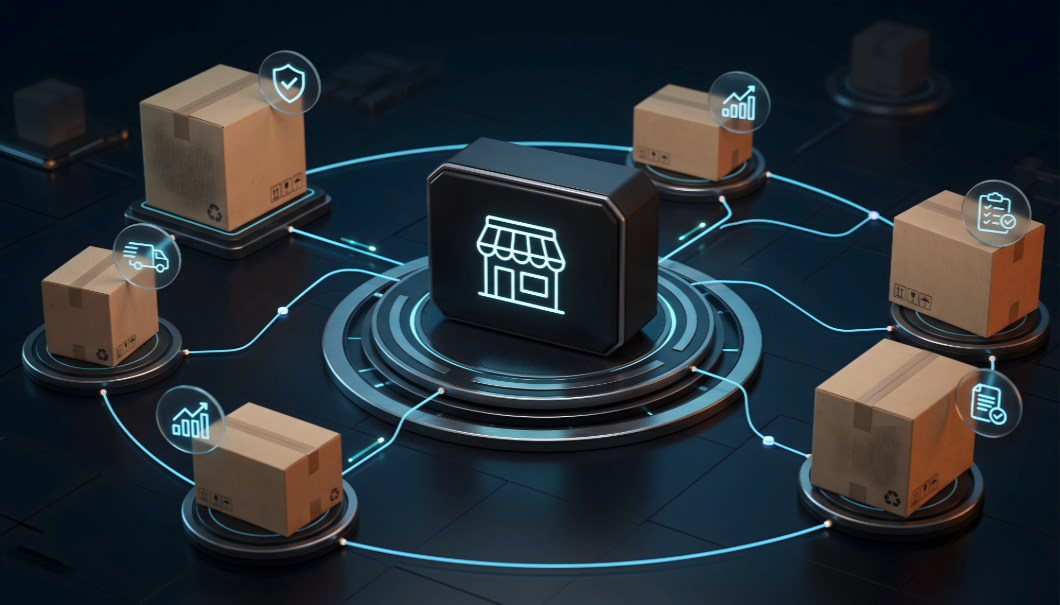
What Is Retail Supply Chain Management?
Retail supply chain management is the process of planning, coordinating, and managing how products move from suppliers and manufacturers to warehouses, retail stores, marketplaces, and ultimately customers.
It covers much more than transportation. A retail supply chain can include:
- Procurement and sourcing
- Supplier management
- Inventory planning
- Warehousing
- Order management
- Transportation
- Distribution
- Retail store replenishment
- E-commerce fulfilment
- Returns and reverse logistics
- Demand forecasting
- Supply chain analytics
The objective is to make sure the right products are available at the right location, at the right time, and at an acceptable cost.
Retail supply chains are particularly complex because retailers often manage high product volumes, multiple suppliers, multiple sales channels, seasonal demand, and customers who increasingly expect fast and reliable delivery.
For example, a retailer selling footwear may source products from several manufacturers, store inventory in one or more warehouses, distribute products to physical stores, fulfil online orders, and replenish fast-selling locations based on demand. All of these activities form part of its retail supply chain.
How Does a Retail Supply Chain Work?
A typical retail supply chain follows a sequence from sourcing to the final customer.
1. Procurement and Sourcing
Retailers first identify products and suppliers based on factors such as:
- Product quality
- Price
- Production capacity
- Lead time
- Reliability
- Minimum order quantities
- Compliance requirements
Strong supplier relationships are important because delays at the procurement stage can affect every downstream activity.
2. Manufacturing or Supplier Fulfilment
Products are manufactured or procured from suppliers according to purchase orders and expected demand.
Retailers need visibility into supplier production schedules so that they can plan warehouse capacity and inventory levels.
3. Transportation
Goods move from suppliers or manufacturers to distribution centres, warehouses, or stores.
Depending on the business, transportation can involve road, rail, air, sea, or a combination of modes.
4. Warehousing
Products are received, inspected, stored, and prepared for distribution.
Warehouse activities can include:
- Receiving
- Put-away
- Inventory tracking
- Picking
- Packing
- Labelling
- Dispatch
- Returns processing
5. Distribution and Replenishment
Inventory is distributed to stores, distributors, marketplaces, fulfilment centres, or customers.
Retailers must continuously decide where inventory should be positioned based on demand and delivery requirements.
6. Order Fulfilment
For e-commerce orders, the process moves from order capture to picking, packing, shipping, delivery, and potentially returns.
For physical retail, inventory may be replenished from distribution centres to stores based on sales velocity and stock levels.
7. Returns and Reverse Logistics
Returned products need to be collected, inspected, restocked, repaired, liquidated, or disposed of depending on their condition and the retailer’s policies.
Key Components of Retail Supply Chain Management
| Component | What It Covers |
| Procurement | Sourcing products and managing suppliers |
| Inventory management | Tracking stock and maintaining appropriate inventory levels |
| Warehousing | Receiving, storing and processing goods |
| Transportation | Moving products between suppliers, warehouses, stores and customers |
| Order management | Capturing and processing customer or business orders |
| Distribution | Allocating inventory across locations and channels |
| Demand forecasting | Predicting future product demand |
| Fulfilment | Picking, packing and dispatching customer orders |
| Returns | Managing reverse movement and returned inventory |
| Analytics | Monitoring performance and identifying opportunities |
Each component affects the others. Poor demand forecasting, for example, can result in excess warehouse inventory or stockouts, while poor warehouse positioning can increase transportation costs and delivery times.
Why Is Retail Supply Chain Management Important?
A well-managed supply chain directly influences retail profitability and customer experience.
Better Inventory Availability
Retailers need enough stock to meet demand without unnecessarily tying up capital in excess inventory.
Lower Operating Costs
Better warehouse utilisation, transportation planning, supplier negotiation, and inventory management can reduce avoidable costs.
Faster Fulfilment
Efficient warehouse and distribution processes make it easier to process orders quickly.
Better Customer Experience
Customers expect products to be available and deliveries to arrive within the promised timeframe. Supply chain performance directly affects these expectations.
Easier Business Expansion
A scalable supply chain allows retailers to enter new cities, add sales channels, and increase product volumes without rebuilding their entire operating model.
Major Challenges in Retail Supply Chain Management
Retail supply chains face several recurring challenges.
1. Demand Uncertainty
Demand can change quickly because of:
- Seasonal trends
- Promotions
- Competitor activity
- Pricing changes
- Consumer preferences
- Unexpected events
Overestimating demand can create excess inventory, while underestimating it can lead to stockouts.
2. Inventory Imbalances
A retailer may have excess inventory in one location while another location is running out of the same product.
This becomes more common when inventory is distributed across multiple warehouses and stores without adequate visibility.
3. Rising Logistics Costs
Transportation, fuel, warehousing, labour, and last-mile delivery can significantly affect margins.
Shipping every order from one central warehouse may also become expensive when customers are geographically distributed.
4. Supplier Disruptions
Supplier delays, production problems, raw material shortages, or transportation disruptions can affect product availability.
Retailers therefore need alternative suppliers and contingency plans for critical products.
5. Omnichannel Complexity
Modern retailers may sell through:
- Physical stores
- Their own websites
- Amazon
- Flipkart
- Myntra
- Meesho
- Quick-commerce platforms
- Distributors
- Modern trade
Each channel can have different order, inventory, packaging, fulfilment, and delivery requirements.
6. Customer Expectations
Customers increasingly expect faster deliveries, accurate orders, real-time updates, easy returns, and consistent availability.
These expectations put additional pressure on warehouse and transportation operations.
Best Practices for Retail Supply Chain Management
1. Use Demand Forecasting
Historical sales data, seasonality, promotions, product trends, and channel-level performance can help retailers estimate future demand.
Forecasts should not be treated as fixed numbers. They should be reviewed regularly as actual sales data becomes available.
2. Position Inventory Strategically
Warehouse location can have a major impact on transportation costs and delivery speed.
Instead of automatically operating from one large facility, retailers should evaluate whether a distributed network makes economic and operational sense.
Factors include:
- Customer locations
- Order density
- Product characteristics
- Delivery SLAs
- Transportation rates
- Warehouse costs
- Inventory holding costs
3. Improve Supplier Communication
Retailers should establish clear processes for:
- Purchase orders
- Production schedules
- Expected delivery dates
- Stock availability
- Quality issues
- Shipment updates
Better communication allows retailers to identify potential delays earlier.
4. Integrate Sales and Inventory Data
Sales, inventory, procurement, warehouse, and finance data should ideally work together rather than being maintained in disconnected systems.
This provides a clearer view of inventory availability and helps teams make faster decisions.
5. Review Warehouse Operations Regularly
Warehouse performance should be assessed through metrics such as:
- Inventory accuracy
- Order processing time
- Picking accuracy
- Storage utilisation
- Dispatch time
- Damage rate
- Return processing time
A warehouse audit can help identify operational bottlenecks and areas where processes or infrastructure need improvement.
6. Use Technology Where It Creates Operational Value
Technology can connect warehouse operations, inventory, orders, transportation, and reporting.
Depending on the business, this may include:
- WMS
- OMS
- ERP
- TMS
- Barcode systems
- Inventory tracking
- Warehouse automation
- Analytics dashboards
The objective should not be to add technology simply for the sake of digitisation. Technology should solve a specific operational problem.
7. Consider Outsourcing Non-Core Operations
Retailers do not necessarily need to own and operate every warehouse themselves.
Outsourcing warehousing and fulfilment to a 3PL can provide access to infrastructure, operational teams, processes, and technology without requiring the retailer to build everything internally.
Retail Supply Chain Management Technology
Technology has become an important part of modern retail supply chains.
A connected technology environment can provide visibility from order creation to inventory movement and final delivery.
For example:
Customer Order → OMS → Inventory Allocation → Warehouse → Picking → Packing → Dispatch → Transportation → Delivery
When these systems are connected, teams can identify inventory availability, order status, fulfilment performance, and operational issues more quickly.
For retailers operating across several locations, technology can also support centralised visibility while individual warehouses continue handling day-to-day operations.
Retail Supply Chain KPIs to Track
Retailers should measure supply chain performance rather than relying only on sales numbers.
| KPI | What It Indicates |
| Inventory accuracy | How closely system inventory matches physical inventory |
| Inventory turnover | How efficiently inventory is being sold |
| Stockout rate | Frequency of products becoming unavailable |
| Order fulfilment rate | Percentage of orders fulfilled successfully |
| Order cycle time | Time required to process an order |
| On-time delivery | Percentage of shipments delivered as promised |
| Warehouse utilisation | How effectively available warehouse capacity is being used |
| Return rate | Percentage of orders returned |
| Logistics cost per order | Transportation and fulfilment efficiency |
| Perfect order rate | Accuracy and completeness of fulfilment |
Tracking these KPIs over time can reveal whether operational improvements are actually producing better results.
Centralized vs Distributed Retail Supply Chain
One of the important decisions for growing retailers is whether inventory should remain concentrated in one location or be distributed across multiple warehouses.
| Factor | Centralized Model | Distributed Model |
| Number of warehouses | Lower | Higher |
| Inventory complexity | Lower | Higher |
| Geographic reach | More limited | Wider |
| Delivery distance | Potentially higher | Potentially lower |
| Warehouse management | Simpler | More complex |
| Inventory positioning | Centralised | Regional |
| Best suited for | Concentrated demand | Geographically distributed demand |
Neither model is automatically better.
A distributed network can improve delivery performance and reduce transportation distances, but it can also increase inventory and operational complexity.
The right structure depends on demand geography, product characteristics, order volumes, service levels, and total supply chain cost.
How to Improve Retail Supply Chain Efficiency
Retailers looking to improve their supply chain can follow a practical process:
Step 1: Map the Existing Network
Identify suppliers, warehouses, transportation routes, stores, fulfilment centres, and customer markets.
Step 2: Analyse Demand
Study sales by product, city, channel, season, and customer segment.
Step 3: Identify Bottlenecks
Look for recurring delays, stockouts, excess inventory, warehouse capacity problems, and transportation inefficiencies.
Step 4: Evaluate Warehouse Locations
Compare existing warehouse locations with actual demand distribution and transportation costs.
Step 5: Review Technology
Identify where disconnected systems or manual processes are limiting visibility.
Step 6: Compare In-House and Outsourced Operations
Determine which activities are strategic to keep internally and which could be handled more efficiently by a 3PL or specialist provider.
Step 7: Measure Results
Set clear KPIs and compare performance before and after implementation.
How Goldfishh Can Support Retail Supply Chain Operations
For retailers dealing with growing inventory volumes, multiple markets, or increasingly complex distribution requirements, warehousing can become one of the biggest operational challenges.
Goldfishh’s WAREOSPACE provides a warehouse-as-a-service model that allows businesses to access shared or dedicated warehouse capacity without necessarily committing to building and operating their own facilities. The model is designed around pay-per-use, asset-light warehousing and can support businesses that need to scale their physical distribution network.
For retailers that need more comprehensive operational support, Goldfishh’s 3PL warehouse services cover areas such as warehouse selection, infrastructure setup, technology implementation, staffing, inventory management, receiving, fulfilment, quality control, returns, and performance reporting.
This can be useful when the problem is not simply finding warehouse space but managing the complete warehouse operation.
Retailers can also evaluate their network before adding new facilities. Goldfishh’s Supply Chain Network Design service focuses on questions such as where warehouses should be located, what type and size of facility is appropriate, whether shared or dedicated warehousing makes sense, and how transportation and technology should fit into the network.
For an existing operation, a supply chain network audit or warehouse audit can help identify inefficiencies before making major infrastructure changes.
The broader objective is to build a retail supply chain that can support changing demand without creating unnecessary fixed infrastructure, inventory, or transportation costs.
Frequently Asked Questions About Retail Supply Chain Management
What is retail supply chain management?
Retail supply chain management is the planning and coordination of procurement, inventory, warehousing, transportation, distribution, fulfilment, and returns involved in getting products from suppliers to retail customers.
What are the main processes in a retail supply chain?
The main processes include sourcing and procurement, manufacturing or supplier fulfilment, transportation, warehousing, inventory management, distribution, order fulfilment, and reverse logistics.
Why is inventory management important in retail supply chains?
Inventory management helps retailers maintain product availability while avoiding excessive stock. Poor inventory management can lead to stockouts, lost sales, excess working capital, and increased storage costs.
What are the biggest retail supply chain challenges?
Common challenges include unpredictable demand, inventory imbalances, rising logistics costs, supplier disruptions, warehouse capacity constraints, omnichannel complexity, and increasing customer delivery expectations.
How does technology improve retail supply chain management?
Technology can connect inventory, orders, warehouses, transportation, and analytics. This can improve visibility, reduce manual work, support better decision-making, and make it easier to identify operational problems.
What is retail logistics management?
Retail logistics management focuses on planning and controlling the movement and storage of products between suppliers, warehouses, stores, fulfilment centres, and customers.
Should retailers outsource supply chain operations?
Outsourcing can make sense when warehousing, fulfilment, transportation, or other logistics functions require more infrastructure or expertise than the retailer wants to manage internally. The decision should be based on cost, control, scalability, service requirements, and operational complexity.
What is a 3PL in retail?
A third-party logistics provider, or 3PL, manages logistics functions for a retailer or brand. Depending on the agreement, this can include warehousing, inventory management, order fulfilment, transportation coordination, returns, technology, and reporting.
What is the difference between centralized and distributed retail supply chains?
A centralized supply chain stores most inventory in fewer locations, while a distributed supply chain positions inventory across multiple regional facilities. Centralization is simpler, while distribution can provide better geographic coverage and potentially faster delivery.
How can retailers optimize their supply chain?
Retailers can optimize their supply chain by improving demand forecasting, positioning inventory strategically, strengthening supplier communication, integrating technology, reviewing warehouse performance, optimizing transportation, and outsourcing suitable operations when required.
Conclusion
Retail supply chain management connects procurement, inventory, warehousing, transportation, distribution, fulfilment, and customer demand into one operating system.
As retailers expand across physical stores, marketplaces, D2C websites, and faster delivery channels, supply chains become more complex. A single warehouse, manual inventory processes, or disconnected systems may work at an early stage but become difficult to manage as order volumes and geographic coverage increase.
The most effective approach is therefore not simply to add more warehouses or technology. Retailers need to understand where demand exists, how inventory should be positioned, which processes create bottlenecks, and which activities should remain in-house or be outsourced.
A combination of demand forecasting, strategic warehouse placement, inventory visibility, technology, regular audits, and flexible 3PL operations can help retailers build a supply chain that is more responsive and scalable.
For businesses evaluating their next stage of growth, the goal should be a retail supply chain that can adapt to demand without adding unnecessary complexity or fixed infrastructure.