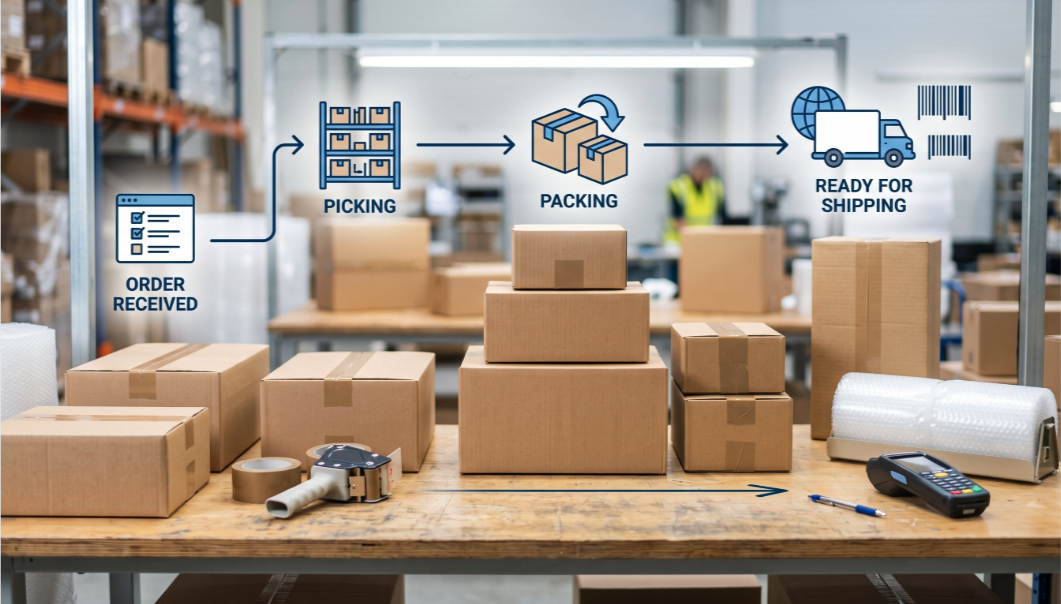
What Is Pick and Pack Fulfillment?
Pick and pack fulfillment is a warehouse process in which products are picked from their storage locations after an order is received and then packed for shipment.
It is an important part of the broader order fulfillment process.
A typical sequence looks like:
Order Received → Inventory Allocated → Picking → Packing → Labelling → Dispatch → Shipping
Picking involves locating and collecting the correct products from warehouse storage. Packing involves placing those products into appropriate packaging along with required documentation and labels before they are handed over for dispatch.
Although the process sounds straightforward, pick and pack fulfillment becomes more complex as order volumes, SKU counts, warehouse locations, and sales channels increase.
For a business processing a few dozen orders a day, manual picking may be manageable. For a retailer or e-commerce brand handling hundreds or thousands of orders across multiple channels, an inefficient picking and packing process can create delays, errors, unnecessary labour costs, and poor customer experience.
That is why warehouse layout, inventory organisation, picking methods, packaging, technology, and workforce planning all influence pick and pack efficiency.
How Does the Pick and Pack Process Work?
A well-structured pick and pack process usually involves several stages.
1. Order Is Received
An order is placed through an e-commerce website, marketplace, sales channel, or another ordering system.
The order needs to be captured accurately before warehouse teams begin fulfilment.
For multi-channel businesses, orders may come from several sources, making order management and inventory synchronisation important.
2. Inventory Is Allocated
The warehouse system identifies where the required products are stored and allocates inventory to the order.
This is where accurate inventory records become critical.
If the system says an item is available but the physical stock is missing, the order can be delayed before picking even begins.
3. Products Are Picked
Warehouse personnel locate the required SKUs and collect them from their storage locations.
The objective is to pick:
- The correct product
- The correct quantity
- From the correct location
- Within the required timeframe
The method used depends on order volume, SKU characteristics, warehouse layout, and operational requirements.
4. Products Move to Packing
Picked products are transferred to a designated packing station.
Here, the team verifies the order and selects appropriate packaging materials.
5. Products Are Packed
The products are placed inside suitable packaging to protect them during transportation.
The packing process may involve:
- Boxes
- Polybags
- Protective material
- Inserts
- Packing slips
- Invoices
- Shipping labels
- Branded packaging
Packaging should protect the product without unnecessarily increasing package size, weight, or shipping cost.
6. Order Is Labelled
The packed shipment receives the required shipping and identification labels.
Accuracy at this stage is important because an incorrect address or label can result in delivery failure or a return.
7. Order Is Dispatched
The completed package is handed over to the appropriate transportation or courier partner for delivery.
This marks the transition from warehouse fulfilment to transportation and last-mile delivery.
What Are the Different Pick and Pack Methods?
The right picking method depends on the warehouse’s order profile.
| Picking Method | How It Works | Best Suited For |
| Piece Picking | One order is picked at a time | Lower order volumes or complex orders |
| Batch Picking | Similar items for multiple orders are picked together | High-volume orders with repeated SKUs |
| Zone Picking | Warehouse is divided into zones and workers pick within assigned zones | Large warehouses with many SKUs |
| Wave Picking | Orders are grouped into scheduled picking waves | High-volume operations with time-based dispatch |
| Hybrid Picking | Multiple methods are combined | Complex multi-channel operations |
Piece Picking
In piece picking, a worker processes one order at a time.
It is relatively simple and can work well when order volumes are low or individual orders contain different products.
Batch Picking
In batch picking, workers pick products for multiple orders together.
For example, if 50 customer orders require the same SKU, a worker can collect the required quantity in one trip rather than visiting the same storage location repeatedly.
Zone Picking
The warehouse is divided into different zones, and workers are assigned specific areas.
An order may move between zones depending on the products it contains.
This can reduce unnecessary movement in large warehouses but requires stronger coordination.
Wave Picking
Orders are grouped into waves based on factors such as delivery deadlines, carrier schedules, order type, or destination.
This allows warehouse teams to coordinate picking and dispatch around operational cut-off times.
Why Is Pick and Pack Efficiency Important?
Pick and pack represents a significant operational activity within many fulfillment warehouses.
Small inefficiencies can become expensive when multiplied across thousands of orders.
1. Better Order Accuracy
A structured process reduces the possibility of picking the wrong SKU or quantity.
2. Faster Order Processing
Efficient warehouse layouts and picking methods can reduce the distance workers need to travel.
3. Lower Labour Costs
When workers spend less time searching for products or walking unnecessarily, the warehouse can process more orders with the available workforce.
4. Reduced Shipping Costs
Appropriate packaging can reduce dimensional weight, packaging consumption, and unnecessary shipping volume.
5. Better Customer Experience
Accurate and timely fulfilment contributes directly to customer satisfaction.
6. Easier Scalability
A standardised process is easier to scale when order volumes increase than an operation dependent on ad-hoc manual procedures.
Common Pick and Pack Warehouse Challenges
Even well-managed warehouses can encounter operational problems.
Inaccurate Inventory
If inventory records are incorrect, workers may not find products where the system indicates they should be.
This can lead to delayed orders, manual searches, substitutions, or cancellations.
Poor Warehouse Layout
If frequently ordered products are located far away from packing or dispatch areas, workers spend more time travelling.
Warehouse layout should consider SKU velocity, product dimensions, storage requirements, and movement patterns.
Excessive Walking
In manual warehouses, employee travel time can represent a significant part of the picking process.
Better slotting, zoning, racking, and picking strategies can reduce unnecessary movement.
Picking Errors
Incorrect products or quantities can result in returns, customer complaints, additional shipping costs, and inventory discrepancies.
Packaging Inefficiency
Using oversized packaging can increase material consumption and transportation costs, while inadequate packaging can increase product damage.
Lack of Real-Time Visibility
When warehouse, inventory, and order systems are disconnected, managers may struggle to understand the current status of orders and stock.
How to Improve Pick and Pack Warehouse Efficiency
Improving pick and pack operations does not always require expensive automation.
Start by understanding where time and errors are occurring.
1. Optimise SKU Placement
High-velocity products should generally be positioned where they can be accessed efficiently.
Warehouse teams can analyse order history and SKU movement to determine appropriate storage locations.
2. Improve Warehouse Layout
The relationship between receiving, storage, picking, packing, staging, and dispatch areas can significantly influence warehouse movement.
A well-designed layout can reduce unnecessary travel and improve workflow.
Goldfishh’s warehouse design and racking services consider factors such as pallet positions, racking height, aisle widths, product zoning, receiving areas, staging areas, and dispatch areas.
3. Use Appropriate Racking
The right racking system can improve storage density while maintaining accessibility.
Depending on product and warehouse requirements, options can include:
- Selective pallet racking
- Drive-in/drive-through racking
- Push-back racking
- Cantilever racking
- Automated storage and retrieval systems
The objective is not simply to maximise storage capacity. The racking configuration should also support efficient picking and safe movement.
4. Introduce Batch or Wave Picking
When order volumes increase, processing every order individually can create unnecessary movement.
Batch or wave picking can consolidate work and improve throughput when the order profile supports it.
5. Standardise Packing Stations
Packing stations should have the required materials and tools readily available.
A standardised station can reduce interruptions and make it easier to train warehouse staff.
6. Use Barcode Scanning
Barcode scanning can help warehouse workers verify products during picking and packing.
This can reduce manual data-entry errors and improve inventory visibility.
7. Connect WMS With Other Systems
A Warehouse Management System can help manage inventory locations, picking, packing, and warehouse workflows.
Goldfishh’s warehouse technology consulting includes WMS and TMS integration with ERP systems, along with barcoding, zone storage, automated picking and packing, and real-time synchronisation between systems.
8. Track Warehouse KPIs
Warehouse managers should measure the process rather than relying on assumptions.
Useful metrics include:
| KPI | What It Measures |
| Pick accuracy | Percentage of orders/items picked correctly |
| Pick rate | Items or orders picked per labour hour |
| Order accuracy | Percentage of orders shipped without errors |
| Order cycle time | Time from order receipt to dispatch |
| Packing time | Time required to pack an order |
| On-time dispatch | Orders dispatched within the required timeframe |
| Inventory accuracy | Difference between system and physical inventory |
| Damage rate | Products damaged during handling |
| Return rate | Orders returned after fulfilment |
Pick and Pack Automation
Automation can become useful when order volumes and operational complexity increase.
Possible technologies include:
- Conveyor systems
- Barcode scanners
- Pick-to-light systems
- Put-to-light systems
- Automated storage and retrieval systems
- Automated guided vehicles
- Robotics
- Warehouse management systems
Goldfishh’s warehouse infrastructure services include conveyor systems, robotics, AGVs, and real-time inventory tracking, while its warehouse design services cover pick-to-light, put-to-light, ASRS, and conveyor automation.
However, automation should follow process optimisation rather than replace it.
If SKU placement, inventory accuracy, warehouse layout, and operational processes are already inefficient, adding automation may simply make a poorly designed process more expensive.
Pick and Pack Fulfillment vs Pick, Pack and Ship
The terms are closely related but describe slightly different stages.
| Process | Meaning |
| Picking | Selecting products from storage |
| Packing | Preparing selected products for shipment |
| Pick and Pack | Picking and packing the ordered products |
| Shipping | Handing the completed shipment to a carrier |
| Pick, Pack and Ship | Complete process from product selection through carrier handover |
Pick and pack is therefore one part of the broader order fulfillment process.
Should Businesses Outsource Pick and Pack Fulfillment?
As order volumes increase, businesses may need more warehouse space, workers, equipment, technology, and operational management.
At that point, outsourcing to a third-party logistics provider (3PL) can be an alternative to building the entire operation internally.
Outsourcing may be worth considering when:
- Order volumes are increasing rapidly
- Warehouse space is becoming a constraint
- Hiring and managing warehouse staff is difficult
- Multiple sales channels need fulfilment
- The business is entering new geographic markets
- Existing warehouse processes are inefficient
- Technology investment is becoming expensive
- Management wants to focus on sales and product development
A 3PL can potentially manage warehouse selection, infrastructure, staffing, inventory, fulfillment, technology, reporting, and daily operations.
Goldfishh’s 3PL offering covers warehouse selection, infrastructure setup, industrial racking, material handling equipment, automation, software implementation, staffing, inventory management, receiving, order fulfillment, quality control, returns, and performance reporting.
How Much Does Pick and Pack Fulfillment Cost?
There is no single standard price for pick and pack services.
The cost can depend on:
- Number of orders
- Number of SKUs
- Items per order
- Product dimensions and weight
- Picking complexity
- Packaging requirements
- Warehouse location
- Storage requirements
- Technology used
- Value-added services
- Return volumes
A fulfillment provider may charge separately for storage, receiving, picking, packing, shipping, returns, and other services.
Businesses should therefore compare the total fulfillment cost per order, rather than looking only at the pick and pack fee.
How Goldfishh Can Support Pick and Pack Fulfillment
For businesses that need to improve warehouse fulfillment without immediately investing in their own infrastructure, Goldfishh’s WAREOSPACE provides a pay-per-use, asset-light warehouse model.
The service provides access to shared or dedicated warehouse facilities and is designed to support distribution, freight, logistics, and e-commerce fulfillment. Goldfishh states that its network includes warehouse options across multiple Indian locations and supports different warehouse requirements, including general, compliant, bonded, chemical, temperature-controlled, cold-chain, and FTZ facilities.
For businesses that need a more complete operational solution, Goldfishh’s 3PL warehouse services cover the infrastructure and daily management required to operate a fulfillment warehouse, including inventory management, receiving, order fulfillment, quality control, returns, staffing, technology, and performance reporting.
The warehouse itself also matters. If poor storage design is slowing down picking, Goldfishh’s warehouse layout and racking services can help businesses evaluate storage configuration, aisle widths, zoning, pallet positions, material handling equipment, and automation opportunities.
For businesses with an existing warehouse, a warehouse audit can be useful before making major changes. It allows operational issues to be evaluated before investing in additional space, equipment, or technology.
And when the problem extends beyond one facility, supply chain network design and network audits can help businesses evaluate whether inventory and warehouse locations are positioned appropriately for their demand and distribution requirements.
The result is a more structured approach: first understand the process, then improve warehouse layout and inventory flow, introduce the right technology, and finally determine whether outsourcing or additional infrastructure is required.
Frequently Asked Questions About Pick and Pack Fulfillment
What is pick and pack fulfillment?
Pick and pack fulfillment is the warehouse process of selecting products from storage after receiving an order and then packing them for shipment.
What are the three steps of fulfillment?
The commonly used sequence is pick, pack, and ship. Picking selects the ordered products, packing prepares them for transportation, and shipping transfers the completed package to the delivery carrier.
What are the main types of warehouse picking?
Common methods include piece picking, batch picking, zone picking, and wave picking. Some warehouses combine multiple methods depending on order volumes and SKU characteristics.
What is a pick and pack warehouse?
A pick and pack warehouse stores inventory in organised locations so products can be retrieved, packed, labelled, and dispatched after customer or business orders are received.
How can I improve pick and pack efficiency?
Start with accurate inventory records and an efficient warehouse layout. Then evaluate SKU placement, racking, picking methods, packing stations, barcode scanning, WMS integration, automation, and employee productivity.
What is a pick and pack fee?
A pick and pack fee is a fulfillment charge associated with retrieving products from warehouse storage and packing them for shipment. Pricing structures vary between providers.
Is pick and pack the same as fulfillment?
No. Pick and pack is one part of the larger fulfillment process. Fulfillment can also include receiving, storage, inventory management, order processing, shipping, delivery coordination, and returns.
When should a business outsource pick and pack fulfillment?
Outsourcing can make sense when order volumes are growing, warehouse space is limited, multiple sales channels need to be fulfilled, or the business does not want to invest in warehouse infrastructure and operational teams.
Does a 3PL handle pick and pack?
Yes. Pick and pack is commonly part of the services provided by 3PL warehouse and fulfillment companies. Depending on the agreement, a 3PL can also handle storage, inventory, receiving, dispatch, returns, technology, and reporting.
Does warehouse layout affect picking efficiency?
Yes. The location of high-volume SKUs, aisle widths, storage systems, packing stations, staging areas, and dispatch points can all influence the amount of movement required to process an order.
Conclusion
Pick and pack fulfillment is a basic warehouse activity, but its impact on overall supply chain performance can be significant.
An inefficient picking process can increase labour requirements, slow order processing, create inventory errors, and delay dispatch. An efficient process combines accurate inventory, logical SKU placement, suitable racking, effective picking methods, standardised packing, trained staff, and appropriate technology.
Businesses should therefore look beyond simply hiring more warehouse workers. Improving the underlying warehouse design and process can often have a greater long-term impact.
As order volumes grow, companies can also evaluate 3PL fulfillment or flexible warehouse models instead of investing immediately in additional fixed infrastructure.
The right approach depends on the business’s order volume, SKU profile, geographic distribution, warehouse capacity, technology maturity, and growth plans. By measuring the right KPIs and continuously improving the pick and pack process, businesses can build a warehouse operation that is faster, more accurate, and easier to scale.