What Is an E-commerce Warehouse?
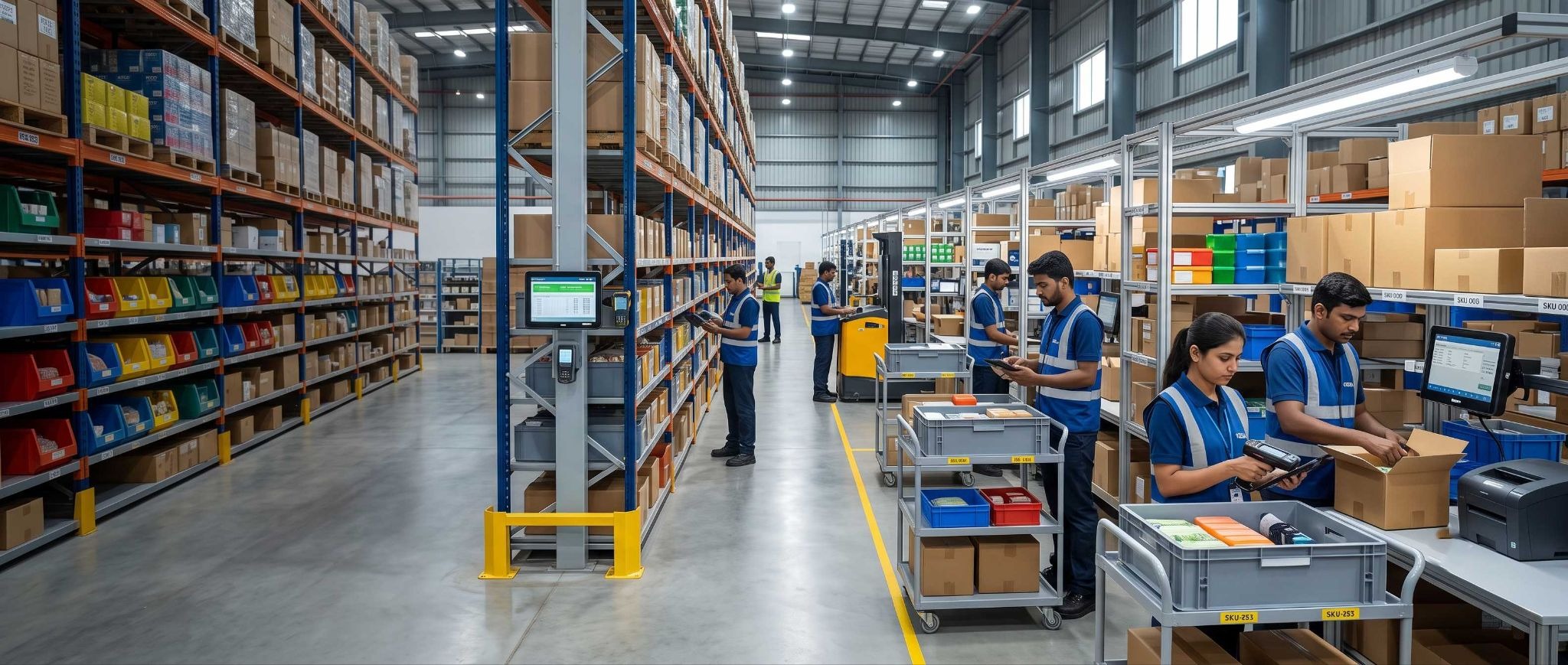
An ecommerce warehouse is a facility designed to store, organize, manage, and distribute products that are sold through online channels.
While a traditional warehouse may primarily focus on storing goods until they are required, an e-commerce warehouse is typically designed around faster inventory movement and frequent customer orders.
Its operations can include:
- Receiving inventory
- Quality checks
- Stock storage
- Inventory tracking
- Order processing
- Picking and packing
- Labelling
- Dispatch
- Returns and reverse logistics
The difference becomes particularly important as an online brand grows.
A small business may initially store products in an office, home, or small rented space. But increasing SKUs, order volumes, marketplace sales, customer expectations, and geographic reach can quickly make manual warehousing difficult to manage.
An e-commerce warehouse provides the infrastructure and processes required to turn stored inventory into efficiently processed customer orders.
How Does an E-commerce Warehouse Work?
An e-commerce warehouse works as part of the broader online order fulfillment process.
A simplified workflow looks like this:
Supplier/Manufacturer → Receiving → Inventory Storage → Customer Order → Picking → Packing → Dispatch → Delivery → Returns
Each stage has a specific operational purpose.
1. Receiving Inventory
Products arrive at the warehouse from manufacturers, suppliers, distributors, or another location.
The warehouse team receives the shipment and records the incoming inventory. Depending on the operation, products may also undergo quantity verification or quality checks before being moved into storage.
2. Inventory Storage
Once received, products are assigned appropriate storage locations.
The warehouse layout may be organized according to:
- SKU
- Product category
- Product size
- Demand
- Handling requirements
- Storage conditions
- Order frequency
Fast-moving products, for example, may need to be positioned so warehouse teams can access them quickly.
3. Inventory Management
Inventory management is one of the most important functions of an e-commerce warehouse.
The business needs to know:
- How much inventory is available
- Where each SKU is stored
- Which products are moving quickly
- Which products are approaching low-stock levels
- Which products are reserved for existing orders
- Which returned products can be resold
Without accurate inventory visibility, brands can experience stockouts, overselling, delayed orders, and unnecessary inventory buildup.
4. Order Processing
When a customer places an order through a D2C website, marketplace, or other digital channel, the order needs to reach the warehouse.
The warehouse team then identifies the required SKUs and creates the appropriate picking task.
For multi-channel brands, this becomes more complex because orders can originate from several platforms simultaneously.
5. Picking
Picking involves locating and collecting the products required for a particular order.
The process can range from manually picking individual products to using more sophisticated warehouse systems and automation.
The objective is straightforward: pick the right product, in the right quantity, for the right order.
6. Packing and Labelling
After picking, products are packed for shipment.
Depending on the brand and product category, this may include customized packaging, protective material, labels, documentation, or product bundling.
The package is then prepared for dispatch.
7. Dispatch and Shipping
The completed order is handed over to a transportation or delivery partner.
An e-commerce warehouse may work with multiple logistics providers depending on delivery location, service requirements, order type, and customer expectations.
8. Returns and Reverse Logistics
The warehouse may also handle returned orders.
Returned products can be received, inspected, recorded, and either returned to sellable inventory or processed according to the brand’s return policy.
This makes reverse logistics an important part of modern e-commerce warehousing.
E-commerce Warehouse vs. Traditional Warehouse
An e-commerce warehouse and a traditional warehouse share basic functions such as receiving and storing inventory, but their operational priorities can be different.
| Factor | Traditional Warehouse | E-commerce Warehouse |
| Primary focus | Storage and bulk movement | Storage + frequent order processing |
| Order size | Often bulk orders | Individual or small orders |
| Picking | Less frequent or bulk-oriented | Frequent SKU-level picking |
| Packing | Often standardized | Customer/order-specific |
| Sales channels | Retail, wholesale, B2B | D2C, marketplaces, Q-commerce, B2B |
| Inventory visibility | Varies by operation | Often technology-driven |
| Returns | May be limited | Important operational function |
| Delivery expectations | Scheduled distribution | Faster, customer-focused delivery |
| Technology | Depends on warehouse | Often integrated with WMS/OMS/e-commerce systems |
The defining characteristic is not simply the type of building.
It is how the warehouse is designed around e-commerce order flow.
What Are the Main Operations in an E-commerce Warehouse?
An efficient e-commerce warehouse typically brings several interconnected activities together.
Receiving and Putaway
Inventory is received, checked, recorded, and moved to its designated storage location.
Inventory Control
Stock levels, SKU locations, movement, replenishment, and availability are monitored.
Picking
Products are collected from storage locations based on customer orders.
Packing
Products are prepared for transportation using appropriate packaging and labels.
Dispatch
Completed shipments are handed over to logistics providers.
Returns Processing
Returned products are received, inspected, and processed.
Order Visibility
Orders can be tracked through different stages from receipt to fulfillment and dispatch.
The more orders and SKUs a business handles, the more important it becomes to standardize these processes.
What Technology Is Used in an E-commerce Warehouse?
Technology plays an increasingly important role in warehouse operations because e-commerce generates a large amount of real-time inventory and order information.
Warehouse Management System
A Warehouse Management System (WMS) helps manage warehouse activities such as inventory locations, receiving, picking, stock movement, and order processing.
For growing businesses, WMS technology can reduce dependence on manual records and improve operational visibility.
Order Management System
An Order Management System (OMS) helps manage orders across different sales channels.
This becomes particularly useful for brands selling through their own website alongside marketplaces and other digital channels.
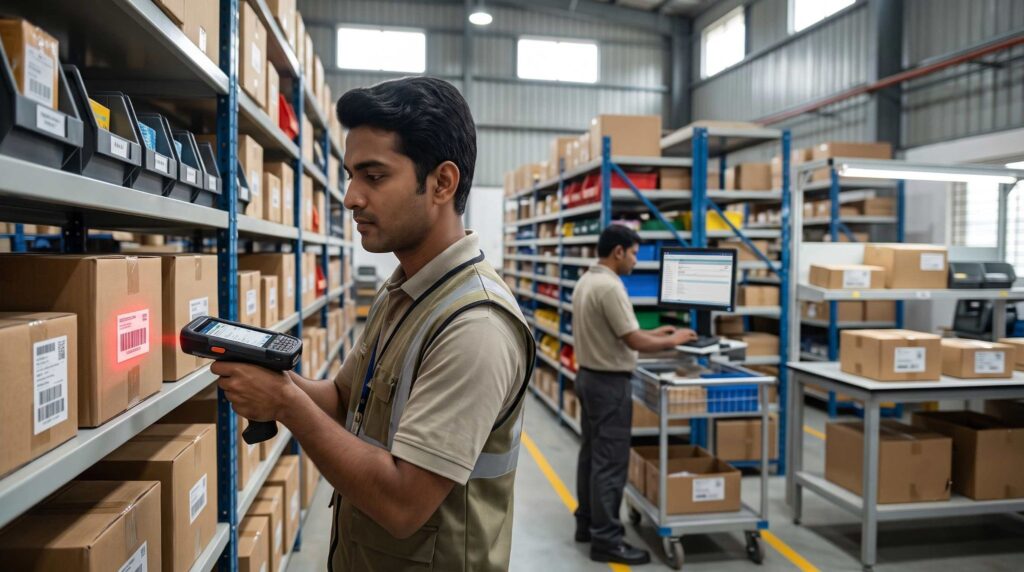
Barcode Scanning
Barcodes can help warehouse teams identify products and track inventory movement.
Scanning at different stages can reduce manual data-entry errors.
Inventory Management Systems
Inventory systems help brands monitor available stock, movements, and order-related inventory across their operations.
E-commerce Integrations
A modern warehouse may need to connect with platforms such as Shopify, WooCommerce, marketplaces, ERPs, OMS platforms, or other business systems.
The objective is to create a more connected flow between sales → orders → inventory → warehouse → fulfillment.
Why Is Technology Important in E-commerce Warehousing?
Imagine a brand selling 2,000 orders every month across three marketplaces and its own website.
If every order needs to be manually checked against spreadsheets, the chances of errors increase.
Now imagine the same business growing to 10,000 orders per month across several channels.
Technology becomes less of an optional improvement and more of an operational requirement.
Technology can help with:
- Real-time inventory visibility
- Order synchronization
- Faster picking
- Barcode-based tracking
- Reduced manual errors
- Inventory replenishment
- Order status visibility
- Multi-channel order management
- Warehouse reporting
The right technology also allows warehouse teams to handle greater operational complexity without increasing manual work at the same rate.
What Are the Different Types of E-commerce Warehouses?
There isn’t one warehouse model suitable for every online business.
Private E-commerce Warehouse
A business owns or directly leases and operates its warehouse.
This provides greater control but also means taking responsibility for infrastructure, staffing, technology, utilities, maintenance, and warehouse management.
Shared Warehouse
Multiple businesses use space within the same warehouse facility.
This can be useful for brands that do not require a dedicated facility or want more flexibility as their inventory changes.
3PL E-commerce Warehouse
A third-party logistics provider manages some or all warehousing and fulfillment activities on behalf of the brand.
This can allow businesses to access existing infrastructure, technology, warehouse teams, and logistics capabilities without building everything themselves.
Fulfillment Center
A fulfillment-focused facility is designed around receiving inventory and processing customer orders, including picking, packing, dispatch, and potentially returns.
Specialized Warehouses
Certain products require specific storage conditions or operational processes.
Examples can include:
- Temperature-controlled storage
- Cold storage
- Bonded warehouses
- Compliant warehouses
- Specialized product-handling facilities
The appropriate model depends on product characteristics, order volumes, geography, sales channels, and growth plans.
What Are the Benefits of Using an E-commerce Warehouse?
1. Better Inventory Organization
A structured warehouse gives every SKU an appropriate location and process.
This makes it easier to find, track, and replenish inventory.
2. More Efficient Order Processing
Standardized picking and packing workflows can help process orders faster and with fewer errors.
3. Scalability
A growing brand can require significantly more storage and fulfillment capacity during periods of rapid growth or seasonal demand.
A flexible warehousing model can help businesses adjust their capacity without continuously rebuilding their own infrastructure.
4. Wider Geographic Reach
A warehouse network can allow brands to position inventory closer to major customer markets.
This can support more efficient distribution and delivery.
5. Reduced Operational Burden
Outsourcing warehousing can reduce the need for a brand to manage warehouse staff, infrastructure, inventory processes, and fulfillment operations internally.
6. Better Customer Experience
Accurate inventory, efficient order processing, reliable dispatch, and effective returns all contribute to the overall customer experience.
When Should a Brand Outsource E-commerce Warehousing?
There is no universal order-volume threshold.
Instead, brands should look at operational complexity.
Consider outsourcing when:
- Your current storage space is becoming insufficient.
- Your order volume is growing quickly.
- You are selling on multiple marketplaces.
- Your team spends too much time processing orders.
- Inventory errors are becoming more common.
- You are expanding into new cities or regions.
- Returns are becoming difficult to manage.
- You need access to warehouse technology without building it internally.
- Seasonal demand requires additional fulfillment capacity.
For some brands, outsourcing can make sense early because they want to remain asset-light. For others, it becomes relevant only after their internal warehouse reaches its practical limits.
How to Choose the Right E-commerce Warehouse
The cheapest warehouse is not necessarily the best warehouse for an e-commerce business.
Evaluate the provider across several dimensions.
| Factor | Questions to Ask |
| Location | Is the warehouse close to important customer markets? |
| Capacity | Can it accommodate current and future inventory? |
| Technology | Does it use WMS/OMS and integrate with your systems? |
| Integrations | Can it connect with your website and marketplaces? |
| Fulfillment | How are picking, packing, and dispatch handled? |
| Scalability | Can capacity increase during peak demand? |
| Returns | Is reverse logistics supported? |
| Reporting | Will you have visibility into inventory and orders? |
| Service levels | What operational SLAs are offered? |
| Specialized needs | Can it handle product-specific storage requirements? |
| Network | Can you access multiple warehouse locations if needed? |
The right warehouse should support the business today without becoming a constraint tomorrow.
How E-commerce Warehousing Supports Omnichannel Growth
Modern brands increasingly operate across multiple sales channels.
A single brand could sell through its:
- Shopify or WooCommerce website
- Amazon
- Flipkart
- Myntra
- Meesho
- Q-commerce platforms
- B2B and modern trade channels
This creates a challenge: the brand needs inventory and fulfillment operations that can support all these channels without creating disconnected processes.
An integrated e-commerce warehouse can act as the physical infrastructure behind this omnichannel model.
Instead of managing each channel independently, brands can work toward a connected system where inventory, orders, fulfillment, and distribution are coordinated across channels.
This is particularly important when a brand moves from simply selling online to actively expanding its digital distribution.
E-commerce Warehouse vs. Fulfillment Center: Are They the Same?
The terms are often used interchangeably, but they can describe slightly different operational priorities.
An ecommerce warehouse emphasizes the storage and management of inventory used for online sales.
A fulfillment center generally places greater emphasis on the movement of customer orders through picking, packing, dispatch, and related processes.
In practice, modern e-commerce facilities often perform both functions.
For a growing brand, the more important question is not what the facility is called but whether it can effectively manage the inventory, orders, technology, fulfillment, and distribution requirements of the business.
How Goldfishh EMBRACE Supports E-commerce Growth
For brands that need e-commerce warehousing as part of a broader online growth strategy, Goldfishh offers EMBRACE, a revenue-growth acceleration service designed around e-commerce, Q-commerce, and omnichannel distribution.
EMBRACE supports D2C brands scaling digital distribution, manufacturers entering marketplaces, offline brands transitioning to omnichannel retail, growth-stage brands expanding their Q-commerce presence, and international brands entering India.
Goldfishh operates a technology-enabled warehouse network across India to support distributed e-commerce fulfillment, Q-commerce appointment delivery, and modern-trade supply chain operations. The current EMBRACE offering specifically includes warehouse fulfillment activities such as OMS-driven order capture, inventory management and GRN processing, picking, packing, labelling, dispatch, returns, customer-service workflows, and order lifecycle visibility.
The model also extends beyond warehouse operations. EMBRACE is designed to help brands expand across marketplaces such as Amazon and Flipkart, Q-commerce platforms such as Blinkit and Zepto, and their own e-commerce websites.
This makes it relevant for a brand that is asking a broader question than “Where should we store our products?”
The question becomes:
“How can we build the warehousing, fulfillment, distribution, and digital commerce capabilities needed to grow across multiple channels?”
For brands at that stage, e-commerce warehousing becomes one component of a larger growth infrastructure—and EMBRACE is positioned to bring those capabilities together.
Frequently Asked Questions About E-commerce Warehouses
What is an ecommerce warehouse?
An ecommerce warehouse is a facility used to store, manage, process, and distribute inventory sold through online channels. Its operations can include receiving, storage, inventory management, picking, packing, dispatch, and returns.
How does an ecommerce warehouse work?
An ecommerce warehouse receives inventory, stores and tracks products, processes customer orders, picks and packs products, dispatches shipments, and may also handle returns.
What is the difference between an ecommerce warehouse and a normal warehouse?
An ecommerce warehouse is generally designed for more frequent SKU-level order processing and direct-to-consumer or marketplace fulfillment. A traditional warehouse may be more focused on storage or bulk distribution.
What technology is used in an ecommerce warehouse?
Common technologies include Warehouse Management Systems, Order Management Systems, barcode scanning, inventory management software, warehouse automation, and integrations with e-commerce platforms and marketplaces.
Is an ecommerce warehouse the same as a fulfillment center?
Not always. An ecommerce warehouse focuses heavily on inventory storage and management, while a fulfillment center is typically more focused on processing customer orders. However, modern facilities can perform both functions.
Should small e-commerce brands use a 3PL warehouse?
A 3PL can be useful when a brand wants to avoid investing heavily in warehouse infrastructure, technology, staff, and fulfillment operations. The decision depends on order volume, product type, growth plans, and operational complexity.
Can an ecommerce warehouse support multiple marketplaces?
Yes. Depending on its technology and integrations, an e-commerce warehouse can support orders from multiple marketplaces as well as a brand’s own website and other sales channels.
How does an ecommerce warehouse help growing brands?
It can help brands organize inventory, process orders efficiently, scale storage and fulfillment capacity, expand geographically, and reduce the operational burden associated with running an internal warehouse.
Conclusion
An ecommerce warehouse is a critical part of the infrastructure behind an online business.
It does far more than store products. A modern e-commerce warehouse connects inventory management, order processing, technology, picking, packing, dispatch, returns, and distribution.
As brands grow, these operations become increasingly complex—particularly when they expand from a single D2C website into marketplaces, Q-commerce, B2B, and other channels.
The right e-commerce warehousing model can give a brand the infrastructure and flexibility it needs to scale without making warehousing itself a growth constraint.
For brands looking to combine this infrastructure with broader marketplace, Q-commerce, and omnichannel revenue growth, a model such as Goldfishh EMBRACE can extend beyond warehousing into the wider digital commerce operation.