What Is an E-commerce Fulfillment Center?
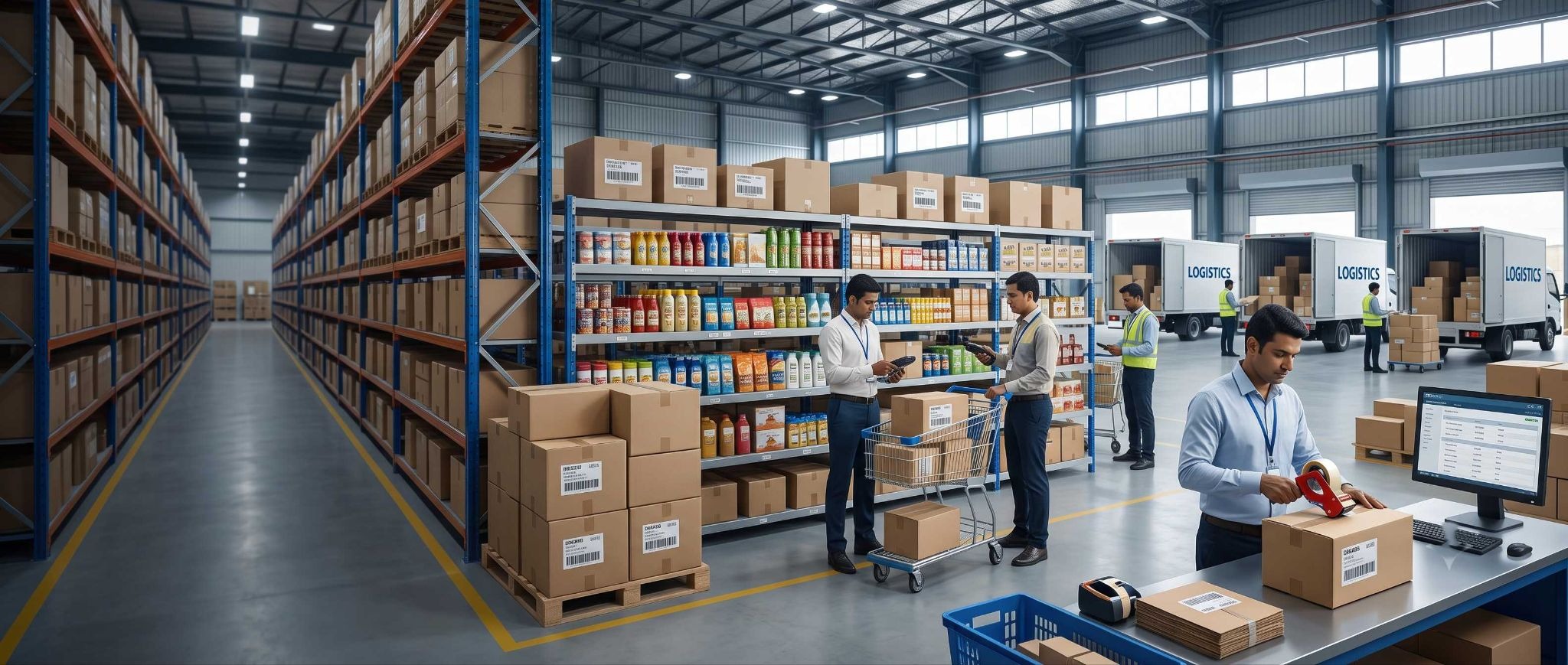
An ecommerce fulfillment center is a facility that stores a brand’s inventory and manages the operational steps required to get an online order from the warehouse to the customer.
Instead of a brand receiving an order, finding the product, packing it, arranging shipping, and managing returns from its own location, these activities can be handled by a fulfillment center or a third-party logistics (3PL) provider.
The process typically covers:
- Receiving inventory
- Storing products
- Managing inventory
- Processing customer orders
- Picking products
- Packing and labeling shipments
- Dispatching orders
- Tracking shipments
- Managing returns
A fulfillment center is therefore more than a place where products are stored. It is an operational hub connecting inventory, orders, warehouse processes, shipping partners, and customers.
For growing e-commerce brands, this distinction becomes important because increasing sales also means increasing operational complexity. A brand may be able to manage 20 or 50 orders a day internally, but handling significantly higher volumes across multiple channels can require additional warehouse space, people, systems, and logistics expertise.
How Does an E-commerce Fulfillment Center Work?
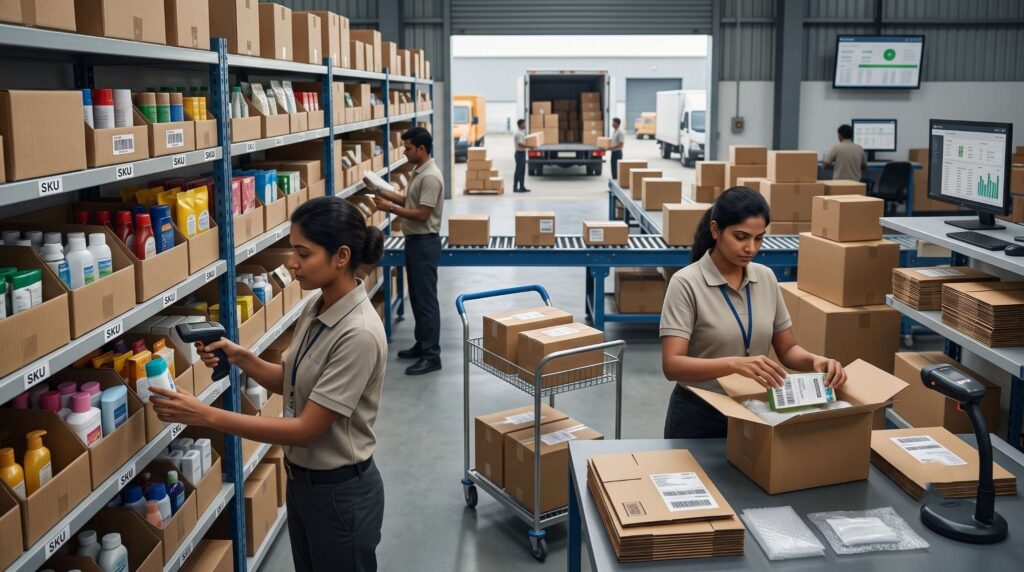
The e-commerce fulfillment process begins before a customer places an order and continues until the product is delivered—and, when necessary, returned.
Here is a simplified view of the process:
Inventory → Receiving → Storage → Order → Picking → Packing → Dispatch → Delivery → Returns
1. Inventory Is Sent to the Fulfillment Center
The brand sends its products to the fulfillment center based on expected demand and its distribution requirements.
The fulfillment provider receives the inventory and records the products in its inventory management or warehouse management system.
This gives the brand visibility into how much stock is available and where it is located.
2. Products Are Stored
Products are placed in designated storage locations inside the facility.
How inventory is stored depends on factors such as product size, category, demand, handling requirements, and expected order volumes.
For example, fast-moving products may need to be positioned for quick access, while products requiring temperature-controlled storage need an appropriate environment.
3. Customer Places an Order
When a customer purchases a product through a D2C website, marketplace, or another online channel, the order needs to reach the fulfillment operation.
Modern fulfillment setups can connect sales channels with order and inventory systems so that order information and stock levels can be managed centrally.
4. The Product Is Picked
Warehouse personnel or automated systems locate the required product and pick it from its storage location.
For brands with many SKUs or high order volumes, efficient picking processes become important because errors at this stage can lead to incorrect deliveries, customer complaints, and additional return costs.
5. The Order Is Packed
Once the products are picked, they are packed according to the brand’s requirements.
This can include:
- Product-specific packaging
- Protective packaging
- Shipping labels
- Invoices or documentation
- Kitting or bundling
- Brand-specific packaging requirements
The objective is to prepare the order for safe and accurate dispatch.
6. The Order Is Dispatched
The packed order is handed over to a suitable shipping or transportation partner.
Depending on the fulfillment model and customer location, orders may be shipped using different carriers and service levels.
A strategically located fulfillment network can help brands position inventory closer to demand, potentially reducing delivery distances and improving delivery speed.
7. Delivery and Tracking
After dispatch, the shipment moves through the delivery network to the customer.
Order tracking gives the brand and customer visibility into the shipment’s progress.
For an e-commerce business, fulfillment doesn’t end when the package leaves the facility. Delivery performance, failed deliveries, customer communication, and returns can all affect the overall customer experience.
8. Returns Are Processed
If a customer returns an order, the fulfillment operation may receive the product, inspect it, update inventory, and route it according to the brand’s return policy.
A well-defined returns process is important because inefficient reverse logistics can tie up inventory and increase operational costs.
E-commerce Fulfillment Center vs. Traditional Warehouse
A traditional warehouse and an e-commerce fulfillment center may look similar, but their operational objectives are different.
| Factor | Traditional Warehouse | E-commerce Fulfillment Center |
| Primary purpose | Storage | Storage + order processing |
| Order type | Often bulk shipments | Individual customer orders |
| Picking | Usually less frequent | Frequent and order-driven |
| Packing | May be basic or bulk-oriented | Customer/order-specific |
| Shipping | Scheduled dispatches | Frequent parcel dispatches |
| Returns | May be limited | Often integrated into operations |
| Technology | Depends on operation | Typically uses inventory/order systems |
| Customer proximity | Not always a priority | Often important for delivery speed |
| Suitable for | Long-term or bulk storage | D2C, marketplace and e-commerce orders |
The key difference is that a fulfillment center is designed around order movement, not simply inventory storage.
As a result, the facility needs processes that can handle frequent orders, picking and packing, shipping coordination, inventory visibility, and returns.
Why Do Growing Brands Use E-commerce Fulfillment Centers?
For a growing brand, fulfillment can become a bottleneck surprisingly quickly.
Sales may be increasing, but the team can simultaneously find itself dealing with warehouse operations, hiring, packing orders, coordinating couriers, maintaining inventory records, and processing returns.
Outsourcing fulfillment can shift much of this operational responsibility to a specialist.
1. Scale Without Building a Larger Warehouse
A brand does not necessarily need to invest immediately in additional warehouse infrastructure simply because order volumes are increasing.
A fulfillment partner can provide access to existing infrastructure and operational teams, allowing the brand to scale its fulfillment capacity according to its requirements.
2. Reduce Operational Complexity
Running fulfillment internally requires more than warehouse space.
Brands may need:
- Warehouse employees
- Inventory systems
- Packing stations
- Shipping relationships
- Processes for returns
- Quality control
- Inventory tracking
A fulfillment provider can bring these capabilities together under one operational model.
3. Improve Inventory Management
A fulfillment center can provide structured inventory receiving, storage, movement, and order processing.
When inventory is connected to order and sales channels, brands can also get better visibility into stock levels and order activity.
4. Support Faster Delivery
The location of inventory has a direct impact on how far products need to travel.
Brands serving customers across multiple regions may benefit from distributing inventory across strategically selected fulfillment locations rather than shipping every order from one warehouse.
This is one reason fulfillment networks can become increasingly valuable as a brand expands geographically.
5. Handle Sales Spikes
E-commerce demand is rarely consistent.
Brands may experience significant order increases during:
- Festive seasons
- Product launches
- Promotional campaigns
- Marketplace sales
- Influencer campaigns
- Seasonal demand
A fulfillment operation with scalable processes can help brands manage these fluctuations without building permanent infrastructure solely for peak periods.
6. Let the Brand Focus on Growth
Perhaps the biggest strategic advantage is focus.
Instead of spending significant management time on packing orders, inventory movement, shipping coordination, and warehouse operations, the brand can focus on areas such as:
- Product development
- Marketing
- Customer acquisition
- Marketplace growth
- Brand building
- New channel expansion
This is one of the core reasons businesses outsource fulfillment to 3PL providers.
When Should a Brand Consider an E-commerce Fulfillment Center?
There isn’t one specific order volume at which every brand should outsource fulfillment.
The right time depends on the complexity of the business.
However, an e-commerce fulfillment center may become worth considering when:
Your order volume is growing rapidly
If your team is spending increasing amounts of time processing orders instead of growing the business, fulfillment may be becoming a constraint.
You are selling through multiple channels
Managing D2C orders alongside Amazon, Flipkart, other marketplaces, or Q-commerce channels can make inventory and fulfillment significantly more complex.
Your current warehouse is running out of space
Limited storage can create operational problems and restrict future growth.
Customers expect faster delivery
As brands expand geographically, storing inventory closer to demand can become an important part of the fulfillment strategy.
Returns are becoming difficult to manage
A structured reverse logistics process can become increasingly important as order volumes grow.
You are entering new markets
A fulfillment network can help a brand expand its operational footprint without necessarily building warehouses independently in every new market.
What Should You Look for in an E-commerce Fulfillment Partner?
Choosing a fulfillment provider should not be based solely on storage price.
Consider the complete operation.
| Factor | What to Evaluate |
| Location | Does the network cover your key customer markets? |
| Technology | Can it integrate with your website and sales channels? |
| Inventory management | Can you get accurate stock visibility? |
| Order processing | What are the picking and packing processes? |
| Scalability | Can the provider handle seasonal peaks? |
| Shipping | Are multiple transportation options available? |
| Returns | Is reverse logistics clearly defined? |
| Product handling | Can it handle your specific product requirements? |
| Value-added services | Are kitting, labeling or customized packaging available? |
| Reporting | Can you track inventory and fulfillment performance? |
The best provider is not necessarily the one with the lowest storage rate. It is the one that can support the operational requirements of the business as it grows.
Can an E-commerce Fulfillment Center Support Multiple Sales Channels?
Yes.
Modern brands increasingly sell through several channels rather than relying on a single online storefront.
For example, a brand may sell through:
- Its own D2C website
- Amazon
- Flipkart
- Myntra
- Meesho
- Q-commerce platforms
- B2B or modern trade channels
This creates a requirement for coordinated inventory and fulfillment operations.
Instead of treating every channel as a separate business, brands can build a connected fulfillment operation where inventory, orders, and warehouse processes are managed as part of a broader omnichannel strategy.
For growing brands, this can be particularly useful when entering marketplaces or Q-commerce because each channel can introduce its own operational requirements.
E-commerce Fulfillment Center: The Bigger Picture
An e-commerce fulfillment center should not be viewed simply as an outsourced warehouse.
It can become an important part of a brand’s growth infrastructure.
A strong fulfillment operation connects inventory, technology, warehouse operations, transportation, marketplaces, and customers.
As the business grows, this infrastructure can help the brand expand into new geographies and sales channels without having to build every operational capability internally.
However, fulfillment alone does not create demand. A brand still needs the right products, positioning, marketing, marketplace strategy, and customer acquisition engine.
That is where fulfillment can become one part of a broader e-commerce growth strategy.
How Goldfishh EMBRACE Can Help Growing Brands
For brands that need more than fulfillment infrastructure, Goldfishh EMBRACE combines e-commerce distribution, fulfillment, and revenue-growth support.
EMBRACE is designed for D2C brands scaling digital distribution, manufacturers entering marketplaces, offline brands moving toward omnichannel retail, growth-stage brands expanding into Q-commerce, and international brands entering India.
The offering supports brands across channels such as Amazon and Flipkart, Q-commerce platforms including Blinkit and Zepto, and the brand’s own e-commerce website. Goldfishh also operates a pan-India warehouse network supporting distributed fulfillment and Q-commerce appointment deliveries.
On the fulfillment side, EMBRACE covers activities including order capture, inventory management, picking, packing, labeling, dispatch, returns, customer-service workflows, and order lifecycle visibility.
This makes EMBRACE relevant for brands that are not simply asking, “Where can I store and ship my products?” but are asking a broader question:
“How can I expand my online distribution and grow revenue without building the entire e-commerce and fulfillment infrastructure myself?”
For such brands, combining fulfillment capabilities with marketplace, Q-commerce, and omnichannel growth support can provide a more integrated path to expansion.
Learn more about Goldfishh EMBRACE
Frequently Asked Questions About E-commerce Fulfillment Centers
What is an e-commerce fulfillment center?
An e-commerce fulfillment center is a facility that stores inventory and manages activities such as order processing, picking, packing, shipping, and returns for online businesses.
How does an e-commerce fulfillment center work?
The process generally involves receiving inventory, storing products, receiving customer orders, picking and packing products, dispatching shipments, tracking deliveries, and processing returns.
What is the difference between a warehouse and a fulfillment center?
A warehouse primarily focuses on storing inventory. A fulfillment center combines storage with active order processing, picking, packing, dispatch, and often returns management.
Is a fulfillment center the same as a 3PL?
A fulfillment center is a physical facility used for fulfillment operations, while 3PL refers to a third-party logistics provider that can manage fulfillment, warehousing, transportation, inventory, and other logistics activities on behalf of a business.
When should an e-commerce brand use a fulfillment center?
Brands should consider a fulfillment center when order volumes, geographic reach, warehouse requirements, sales channels, or operational complexity make in-house fulfillment difficult to manage efficiently.
Can fulfillment centers handle marketplace orders?
Yes. Fulfillment operations can support orders from marketplaces as well as D2C websites and other sales channels, depending on the provider’s technology and operational capabilities.
Can an e-commerce fulfillment center manage returns?
Many fulfillment providers offer returns or reverse-logistics processes, including receiving returned products, inspection, inventory updates, and further processing according to the brand’s requirements.
Does using a fulfillment center help a brand scale?
It can. A fulfillment partner can provide access to warehouse infrastructure, operational expertise, technology, and distribution capabilities, allowing brands to expand without building every fulfillment function internally.
Conclusion
An ecommerce fulfillment center is much more than a storage facility. It is an operational system that helps brands manage the journey from inventory receiving to order delivery and returns.
For growing brands, outsourcing fulfillment can reduce operational complexity, support geographic expansion, improve inventory management, and free internal teams to focus on growth.
The important question is not simply whether a brand needs a warehouse. It is whether its fulfillment infrastructure can keep pace with its sales channels, customer expectations, order volumes, and expansion plans.
And for brands looking to combine fulfillment with broader marketplace, Q-commerce, and omnichannel growth, solutions such as Goldfishh EMBRACE can provide a more integrated approach to scaling online revenue.